




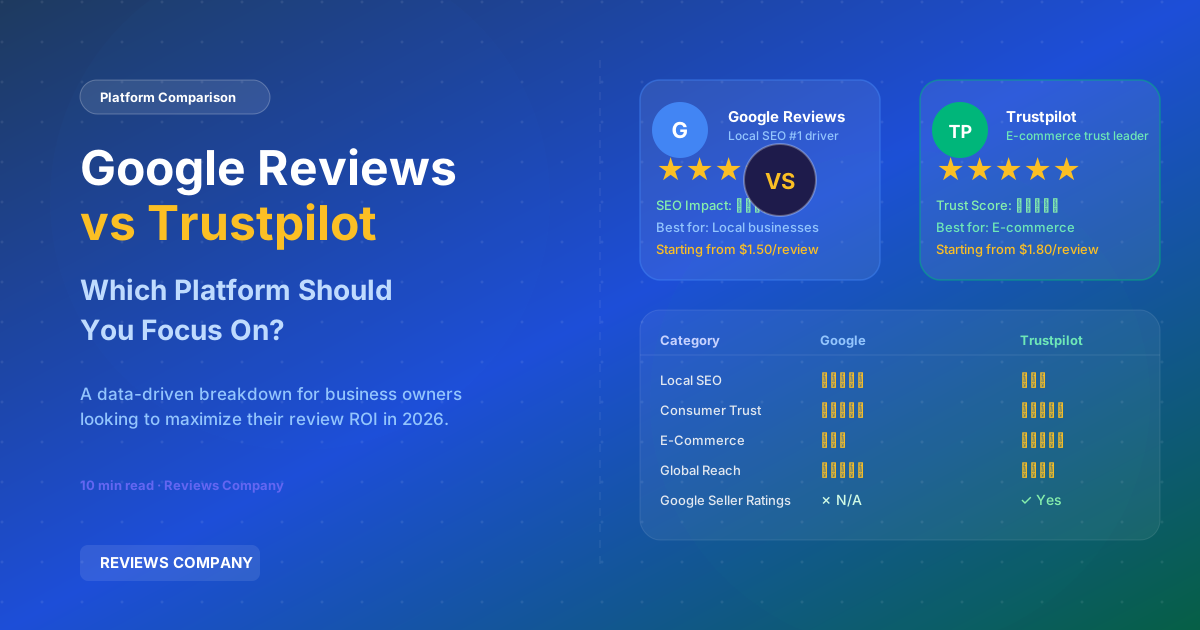
Google Reviews vs Trustpilot: Which Platform Should You Focus On?
When businesses ask us which review platform they should prioritize, the answer is almost never a simple "Google" or "Trustpilot." The right answer depends on your industry, your customers, your sales funnel, and the specific goals you are trying to achieve. But the question is worth answering carefully, because investing review budget and effort in the wrong platform is a real and common mistake.
In this guide, we compare Google Reviews and Trustpilot across every dimension that matters — SEO impact, audience reach, trust signals, cost, and industry fit — and give you a framework for deciding where to focus.
The Core Difference: Intent vs Trust
At their most fundamental level, Google Reviews and Trustpilot serve different consumer needs.
Google Reviews are discovery-stage social proof. They appear when someone is actively searching for a type of business and deciding which one to visit or contact. They influence whether someone clicks on your listing in the first place. They are most powerful for local businesses and high-intent, location-based search.
Trustpilot is pre-purchase validation. It functions as an independent, verifiable trust signal that appears when someone is already considering your business and wants to confirm you are legitimate before buying. Its reviews are frequently displayed on your own website (via Trustpilot widgets) and appear in Google search results for branded searches. It is most powerful for e-commerce, SaaS, and service businesses with a broad geographic footprint.
SEO Impact: Where Reviews Show Up in Search
Google Reviews and Local Search
Google Reviews have the most direct, unambiguous SEO benefit for local businesses. Review count, rating, and recency are confirmed ranking factors in Google's local algorithm. A higher Google Review rating and count means:
- Higher placement in the Google Local 3-Pack for relevant searches
- Star ratings displayed directly in search results (increasing click-through rates by 15–20% according to Moz research)
- Rich snippets on your Google Business Profile
- Improved prominence signals across all local ranking factors
Trustpilot and Organic Search
Trustpilot's SEO benefit is different but equally real. Trustpilot pages for individual businesses frequently rank on the first page of Google for branded search queries (e.g., "[Company Name] reviews"). If your Trustpilot profile has a 4.5-star rating with hundreds of reviews, that first-page result is an asset. If it has 2.8 stars from a handful of angry customers, it is a liability.
Trustpilot also enables Google Seller Ratings — star ratings that appear in Google Ads — which can increase paid search click-through rates by up to 17%. For businesses running Google Ads, a verified Trustpilot profile with sufficient reviews can have meaningful ROI from ad performance alone.
Audience and Reach
Google Reviews
Google Reviews reach anyone who searches on Google — which is effectively everyone. There is no niche or segment that does not use Google. Your Google review rating is visible to every potential customer who searches for your business name or your service category, making it the highest-reach review platform in existence by a wide margin.
Trustpilot
Trustpilot has a strong and growing audience, particularly in the UK, Netherlands, and Denmark where it originated, and increasingly in North America and Australia. It is particularly influential in e-commerce, financial services, travel, utilities, and SaaS sectors. Consumers in these categories are more likely to actively seek out Trustpilot reviews as part of their research process than consumers in, say, food service or home improvement.
Verification and Trust Credibility
Both platforms verify reviews, but in different ways.
Google Reviews are tied to Google accounts and can be gated with photos and location history. However, Google's verification is relatively permissive — the same account can leave reviews for any business, which is why volume and quality control matters.
Trustpilot operates an invitation-based system where businesses can invite customers who have genuinely transacted to leave reviews. It also allows unsolicited reviews from any consumer. Trustpilot's Consumer Investigation Team actively removes fraudulent reviews. Its "Verified" badge carries significant credibility with consumers who are familiar with the platform, because they understand reviews come from real customers with proof of purchase.
Industry Fit: Which Platform Is Right for You?
Prioritize Google Reviews if:
- You are a local business (restaurant, dentist, plumber, salon, retail store, law firm, gym)
- Your customers find you through local search
- Your sales happen primarily in person or over phone/email following local discovery
- You want the single highest-impact move for local SEO
Prioritize Trustpilot if:
- You operate an e-commerce store selling to customers nationally or internationally
- You are in financial services, insurance, utilities, SaaS, or travel
- Your customers research you online before converting and look for independent validation
- You run Google Ads and want Google Seller Ratings to improve ad performance
- You want to embed a review widget on your website that does not link traffic to a competitor
Can You Do Both?
Absolutely — and for many businesses, you should. The most comprehensive reputation strategies treat Google Reviews and Trustpilot as complementary, not competing. A local service business should build a strong Google Review base first (it has the most direct revenue impact), then expand to Trustpilot to capture the branded search validation layer and enable Google Seller Ratings.
For e-commerce businesses, the priority may be reversed — Trustpilot for on-site conversion and Google Ads performance, then Google Business Profile for any physical locations or local service areas.
The Verdict
If you can only invest in one platform right now:
- Local business? → Google Reviews, without question.
- E-commerce / SaaS / financial services? → Trustpilot first, Google second.
- Mixed model (local + national/online sales)? → Build both in parallel, Google first.
The worst outcome is neglecting both. In 2026, a business with fewer than 20 reviews across all platforms has a significant credibility gap that affects every stage of the customer journey — from search ranking to final conversion. Wherever you start, start now.