




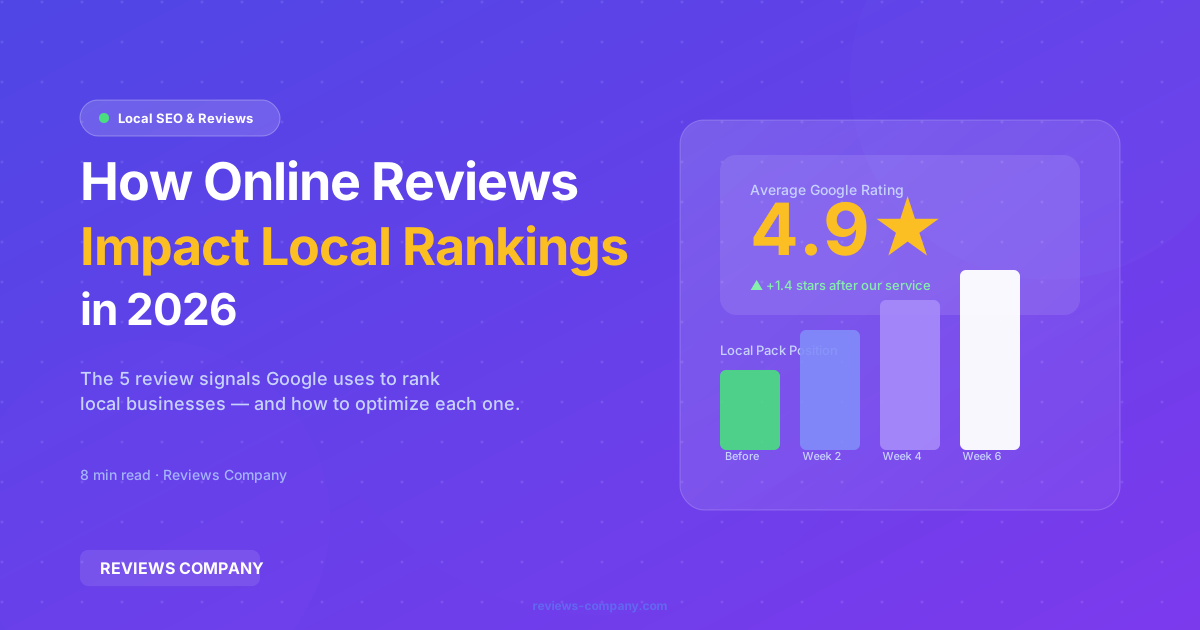
How Online Reviews Impact Local Business Rankings in 2026
If you run a local business and you are not actively managing your online reviews, you are leaving revenue on the table. Multiple independent studies — and Google's own documentation — confirm that reviews are among the strongest signals Google uses to determine which businesses appear in the coveted local 3-pack and Local Finder results.
In this guide, we break down exactly how Google uses reviews in its local ranking algorithm, which review signals matter most, and what practical steps you can take today to improve your review profile — and, by extension, your local visibility.
Why Reviews Matter More Than Ever in 2026
Google's recent core updates have consistently elevated the importance of experience, expertise, authority, and trustworthiness — the E-E-A-T framework — in its ranking signals. For local search, reviews are the most direct public signal of trustworthiness and real-world customer experience. Google cannot easily fake what hundreds of customers are saying about your business on its own platform.
According to BrightLocal's 2024 Local Consumer Review Survey, 98% of consumers read online reviews for local businesses, and 46% say reviews are the most important factor when choosing a local service provider. Google knows this consumer behavior and rewards businesses that demonstrate strong, consistent review profiles.
The 5 Review Signals Google Uses for Local Ranking
1. Review Quantity
All else being equal, a business with 200 Google reviews will outrank a comparable business with 20. Review count is the simplest review signal and the one most businesses understand intuitively. However, it is a starting point, not the finish line.
2. Review Recency
A review from three years ago tells Google far less about the current state of your business than a review from last month. Google weights recent reviews more heavily, which is why businesses need a steady, ongoing flow of new reviews rather than a one-time burst. A business that received 50 reviews last quarter will often outrank one that received 500 reviews two years ago and has gone quiet since.
3. Review Rating (Average Star Score)
Your average star rating is prominently displayed in local results and directly influences click-through rates as well as ranking position. Businesses in the Google 3-pack typically maintain ratings of 4.0 or above. A drop from 4.5 to 3.8 can push you out of the pack entirely in competitive markets. Ratings matter not just for ranking but for conversion — users are significantly less likely to click on a 3.6-star business than a 4.7-star business in the same results.
4. Review Diversity and Keywords in Reviews
Google reads and processes the text content of your reviews. When customers mention your services by name — "best Italian restaurant in downtown Austin," "fast reliable plumber in Brooklyn" — those keywords contribute to your local relevance for those search terms. Encouraging detailed, descriptive reviews has a compounding SEO benefit beyond the star rating alone.
5. Review Response Rate and Speed
Google considers whether and how quickly businesses respond to reviews. Businesses that actively respond to both positive and negative reviews signal to Google that they are engaged, operating, and customer-focused. Response rates above 75% are associated with stronger local pack performance across multiple correlation studies.
Beyond Google: Multi-Platform Review Signals
While Google Reviews carry the most direct weight for local search, Google also factors in review signals from third-party platforms. High ratings on Yelp, TripAdvisor, Facebook, and industry-specific sites like Healthgrades or Avvo contribute to your overall authority signals. For E-E-A-T purposes, a business that is consistently well-reviewed across multiple independent platforms is inherently more trustworthy than one with strong reviews only on its own Google profile.
This is why a comprehensive reputation strategy targets Google first but does not stop there. Building a robust presence across the review platforms most relevant to your industry creates a reinforcing signal across the entire web.
How Many Reviews Do You Need?
There is no magic number, but here are practical benchmarks by market competitiveness:
- Small markets / low-competition categories: 25–50 Google Reviews with a 4.2+ average is often enough to reach the local 3-pack.
- Medium markets / moderate competition: 75–150 reviews with a 4.4+ average is typically required to consistently appear in pack results.
- Large metros / high-competition categories: 200+ reviews with a 4.5+ average and active recency (5+ new reviews per month) is the standard for top-3 placement in markets like New York, Los Angeles, Chicago, and Miami.
These numbers are directional, not absolute. Proximity, relevance, and citation consistency also factor into local ranking. But review volume and quality are often the most actionable lever small business owners can pull.
Actionable Steps to Improve Your Review Profile
Step 1: Audit Your Current Position
Before you can improve, you need to know where you stand. Search for your business category + location in Google and note which competitors appear in the local 3-pack. Compare their review counts, average ratings, and recency to yours. This sets your benchmark.
Step 2: Create a Consistent Review Request Process
The easiest reviews to get are the ones you ask for. Build a review request touchpoint into every customer interaction — post-service follow-up emails, SMS receipts, QR codes on receipts, and verbal requests from staff. Studies show that simply asking dramatically increases review rates.
Step 3: Respond to Every Review
Set a goal of responding to 100% of reviews within 48 hours. For positive reviews, thank the customer and reinforce a specific service detail they mentioned. For negative reviews, apologize, offer a specific resolution, and invite them to continue the conversation privately. Never argue in public responses.
Step 4: Distribute Review Requests Across Platforms
Once your Google review base is established, begin encouraging reviews on the platform most relevant to your industry — Yelp for restaurants and home services, TripAdvisor for hospitality, Glassdoor if you are recruiting, G2 or Capterra for software. Diversifying your review footprint strengthens your overall authority and protects against algorithm changes on any single platform.
Step 5: Consider Professional Review Services
For businesses starting from zero or significantly behind competitors, organic review acquisition alone can take 12–24 months to build a competitive review profile. Professional review delivery services like Reviews Company can accelerate this timeline significantly, delivering real reviews from verified accounts to help you reach competitive thresholds faster while your organic process scales up.
The Bottom Line
Reviews are no longer a "nice to have" for local businesses — they are table stakes for visibility in 2026. The businesses dominating local search results in every category and market share one thing in common: strong, consistent, multi-platform review profiles that signal trust, engagement, and ongoing customer satisfaction to Google's algorithm.
The good news is that reviews are entirely within your control. With the right strategy — consistent solicitation, active responses, platform diversification, and where needed, professional support — any business can build the review profile it deserves.